How Much Nattokinase Is Too Much? What the Research Says About High FU Doses
When does a nattokinase dose become “too much”?
Human research gives us a better answer than simply looking at the biggest FU number on a supplement label.
Studies have evaluated nattokinase exposures from several thousand FU per day to exposures characterized at approximately 13,000 FU per day.
But a dose studied in humans is not the same thing as an established safe upper limit.
There is currently no established maximum safe dose or tolerable upper intake level for nattokinase.
The Short Answer
Human studies and safety evaluations have included high-FU nattokinase exposures with no notable or noticeable adverse effects reported under the conditions studied.
Among the higher-dose human research:
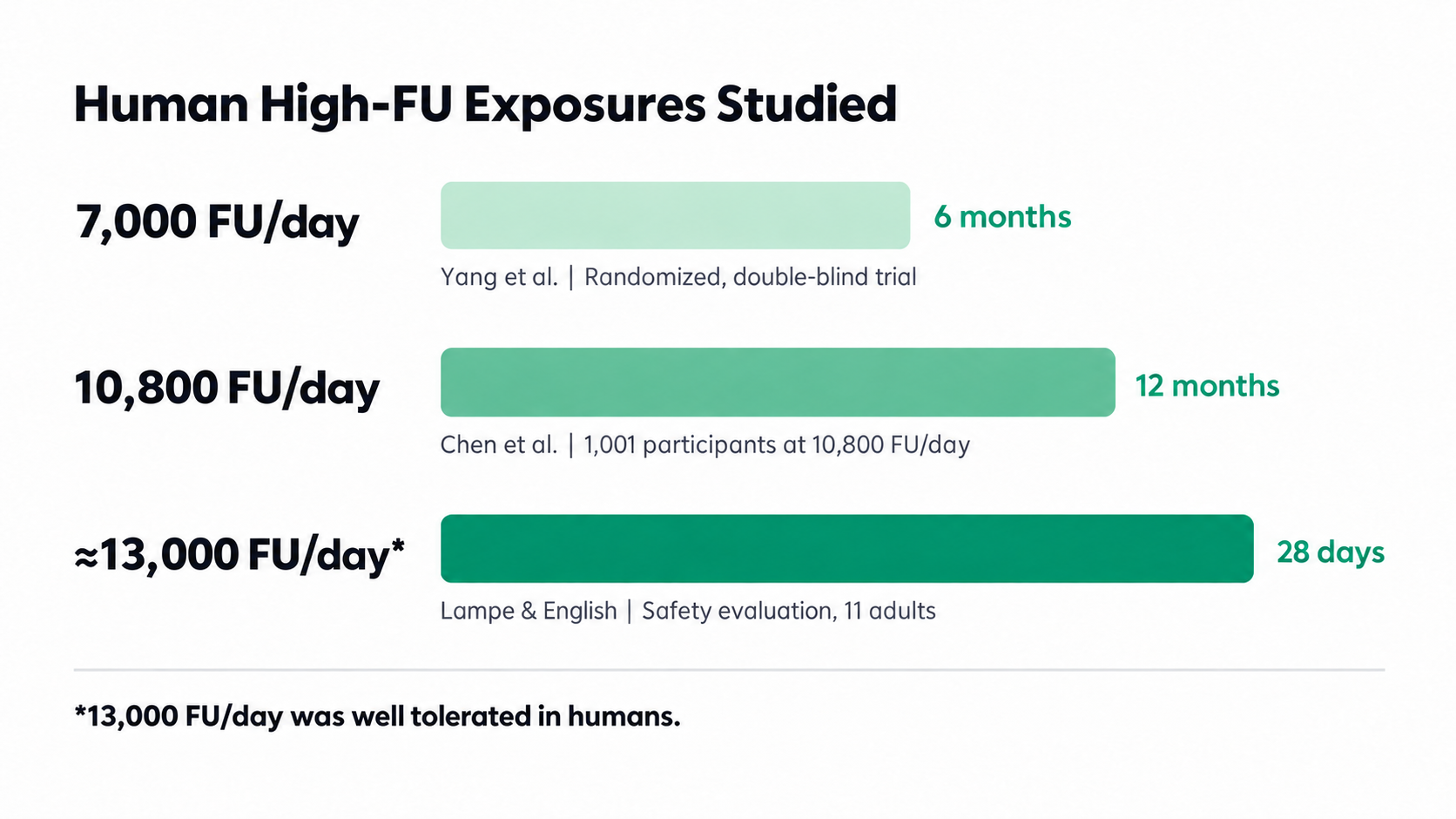
• 7,000 FU/day was studied for six months.
• 10,800 FU/day was studied for 12 months.
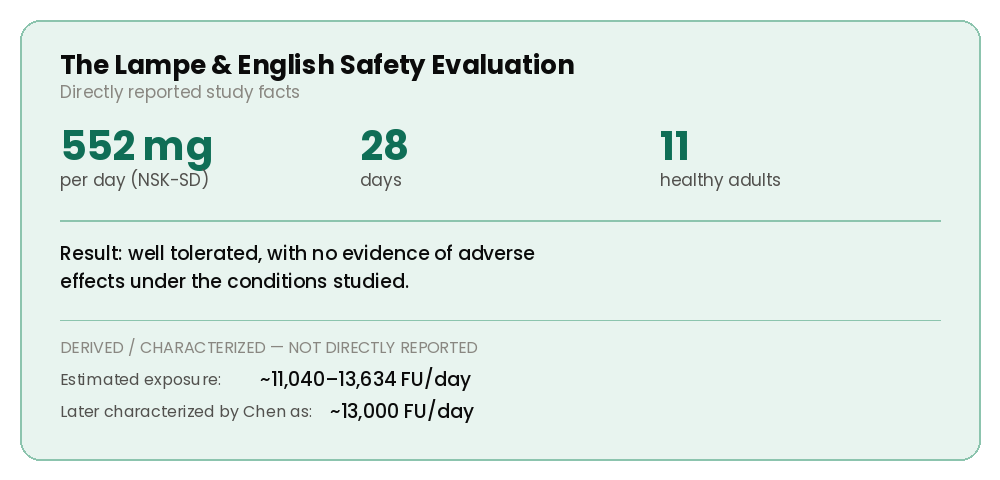
• Lampe and English evaluated 552 mg/day of NSK-SD for 28 days. Based on the activity range of NSK-SD material used across their studies, this corresponds to an estimated 11,040–13,634 FU/day. The exact FU activity of the human-study batch was not reported. Chen later characterized the exposure as approximately 13,000 FU/day.
These are studied human exposures—not established safety thresholds.
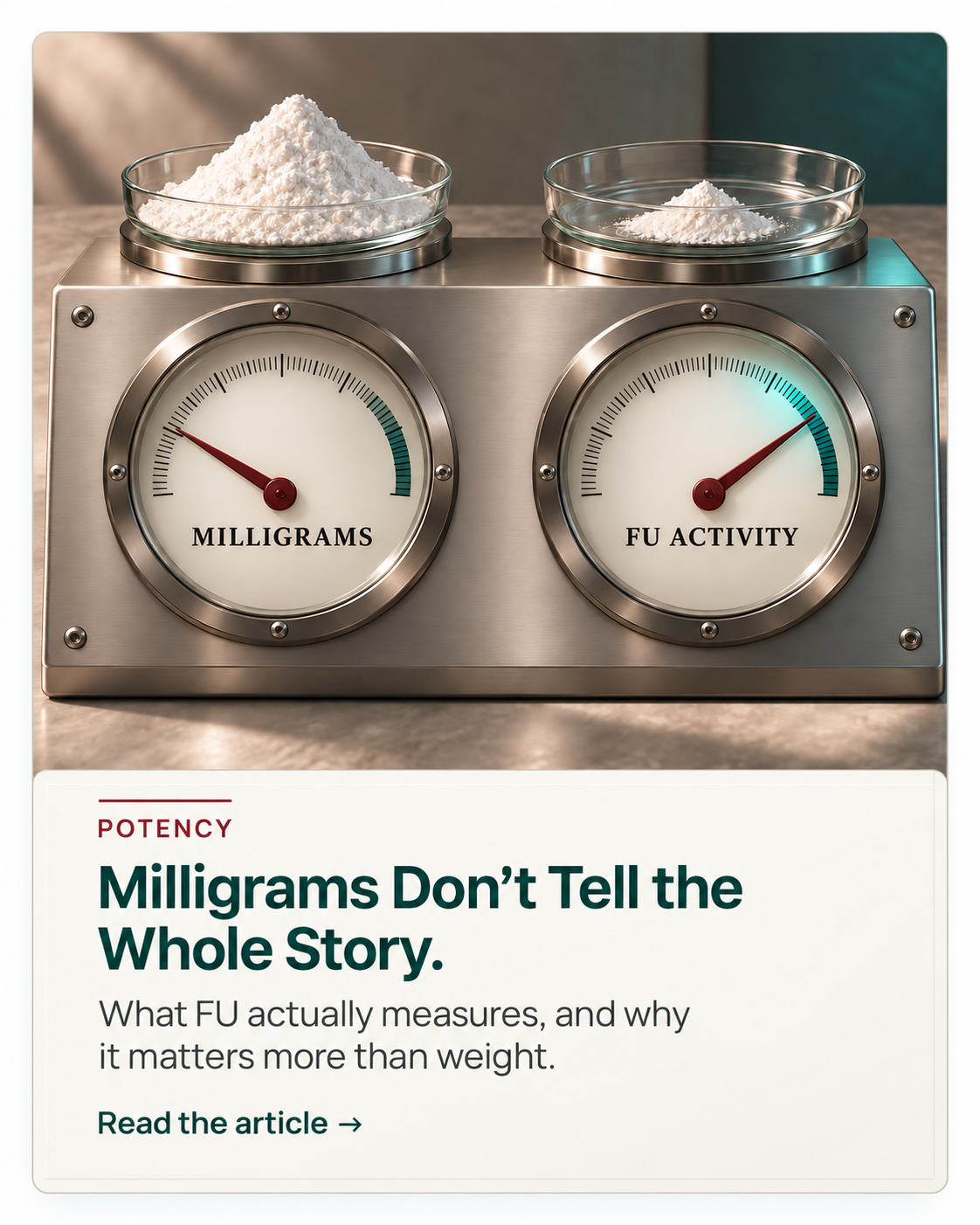
FU stands for fibrinolytic units, an activity measurement used to describe nattokinase's ability to break down fibrin under defined laboratory conditions.
That matters because nattokinase should not be evaluated by milligrams alone.
Two preparations can contain the same weight of material while providing very different measured enzyme activity.
What Does “High FU” Actually Mean?
FU stands for fibrinolytic units, an activity measurement used to describe nattokinase's ability to break down fibrin under defined laboratory conditions.
That matters because nattokinase should not be evaluated by milligrams alone.
Two preparations can contain the same weight of material while providing very different measured enzyme activity.
How High Have Human Nattokinase Doses Actually Gone?
Several human studies help define the exposures researchers have actually evaluated.
They differ in design, population, duration and purpose, but together they provide real human dose and safety data.
7,000 FU Per Day: Six Months
Yang and colleagues conducted a randomized, double-blind, placebo-controlled study involving adults with hyperlipidemia.
The nattokinase-only group received 7,000 FU per day for six months.
No notable adverse events were reported, and safety laboratory measures remained stable over the study period.
10,800 FU Per Day: Twelve Months
Chen and colleagues reported a retrospective analysis of 1,062 participants who had consumed nattokinase for 12 months, with 10,800 FU/day representing the principal higher-dose exposure evaluated.
The investigators reported no noticeable adverse effects associated with nattokinase use.
The duration makes this study particularly important: 10,800 FU/day was evaluated over 12 months, not simply as a short-term exposure.
Study design, participant characteristics and the retrospective nature of the analysis still matter.
We examine the design, findings and limitations of the Chen research separately in our deep dive into the 10,800 FU nattokinase study.
The Lampe Safety Evaluation: An Exposure Later Characterized at ~13,000 FU/Day
One of the highest human exposures cited in discussions of nattokinase safety comes from a toxicological assessment by Lampe and English.
Eleven healthy adults consumed 552 mg/day of NSK-SD for 28 days.
The important distinction is that Lampe reported the administered amount in milligrams—not an exact FU/day value for the human-study batch.
The NSK-SD material used across their studies ranged from 20,000–24,700 FU/g. Applying that range to 552 mg/day gives an estimated exposure of approximately 11,040–13,634 FU/day.
The exact FU activity of the specific batch used in the human study was not reported.
Chen later characterized the Lampe exposure as approximately 13,000 FU/day. Throughout this article, “approximately 13,000 FU/day” should therefore be understood as research context for the Lampe study—not as a directly reported or independently measured FU dose.
The investigators concluded that 552 mg/day for four weeks was well tolerated by the 11 healthy adults studied, with no evidence of adverse effects under those conditions.
The study was small, so its findings should be interpreted within those boundaries.
These studies evaluated specific nattokinase preparations under defined research conditions. Their findings should not be assumed to establish the safety of a different finished product at a similar FU level.
For the broader clinical evidence base beyond dose and safety, see our review of human nattokinase study results.
Is 13,000 FU of Nattokinase “Safe”?
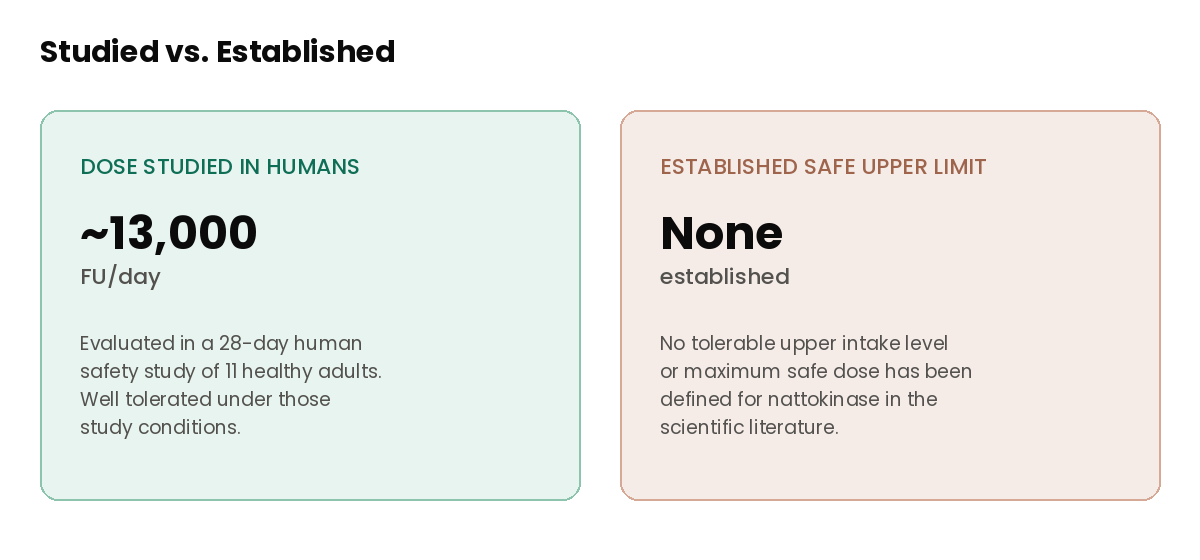
Approximately 13,000 FU/day is best understood as an approximate characterization of the Lampe research exposure—not as an exact FU dose reported for the human-study batch.
The 552 mg/day exposure was well tolerated in 11 healthy adults over 28 days.
That is useful safety evidence within the conditions of the study, but it does not establish 13,000 FU/day as a universally safe dose.
Why Isn't There a Maximum Safe Dose or UL for Nattokinase?
There is currently no established tolerable upper intake level, maximum safe dose or universally accepted safety ceiling for nattokinase.
Establishing one requires more than identifying the highest exposure used in a study. Researchers need sufficient information about dose-response relationships, adverse events, susceptible populations, duration of exposure and the point at which risk begins to increase.
That evidence base does not yet exist for nattokinase.
Dose Is Not the Only Safety Question
FU matters, but it is not the only factor that determines whether nattokinase is appropriate for an individual.
Nattokinase has fibrinolytic activity. That makes medication use, bleeding risk and other factors particularly important.
People using anticoagulant or antiplatelet drugs—including aspirin—should discuss nattokinase with an appropriate healthcare professional before use.
A published case report described a cerebellar hemorrhage in a patient with cerebral microbleeds who was taking aspirin and added nattokinase. A single case cannot establish the frequency or magnitude of an interaction, but it illustrates why combining agents that can affect hemostasis deserves caution.
The same principle applies when nattokinase is considered alongside anticoagulant, antiplatelet or other fibrinolytic therapies.
Nattokinase Is Not a Substitute for Prescribed Anticoagulant Therapy
Nattokinase should not be used as a substitute for prescribed anticoagulant therapy. Any change to prescribed anticoagulant treatment should be made only under the direction of the prescribing clinician.
Do not stop, reduce or replace a prescribed anticoagulant based on nattokinase research or an FU number on a supplement label.
What Matters Besides the FU Number?
One of the easiest mistakes in evaluating nattokinase is assuming that a larger FU number automatically means a better product.
Activity matters, but activity is only part of the formulation.
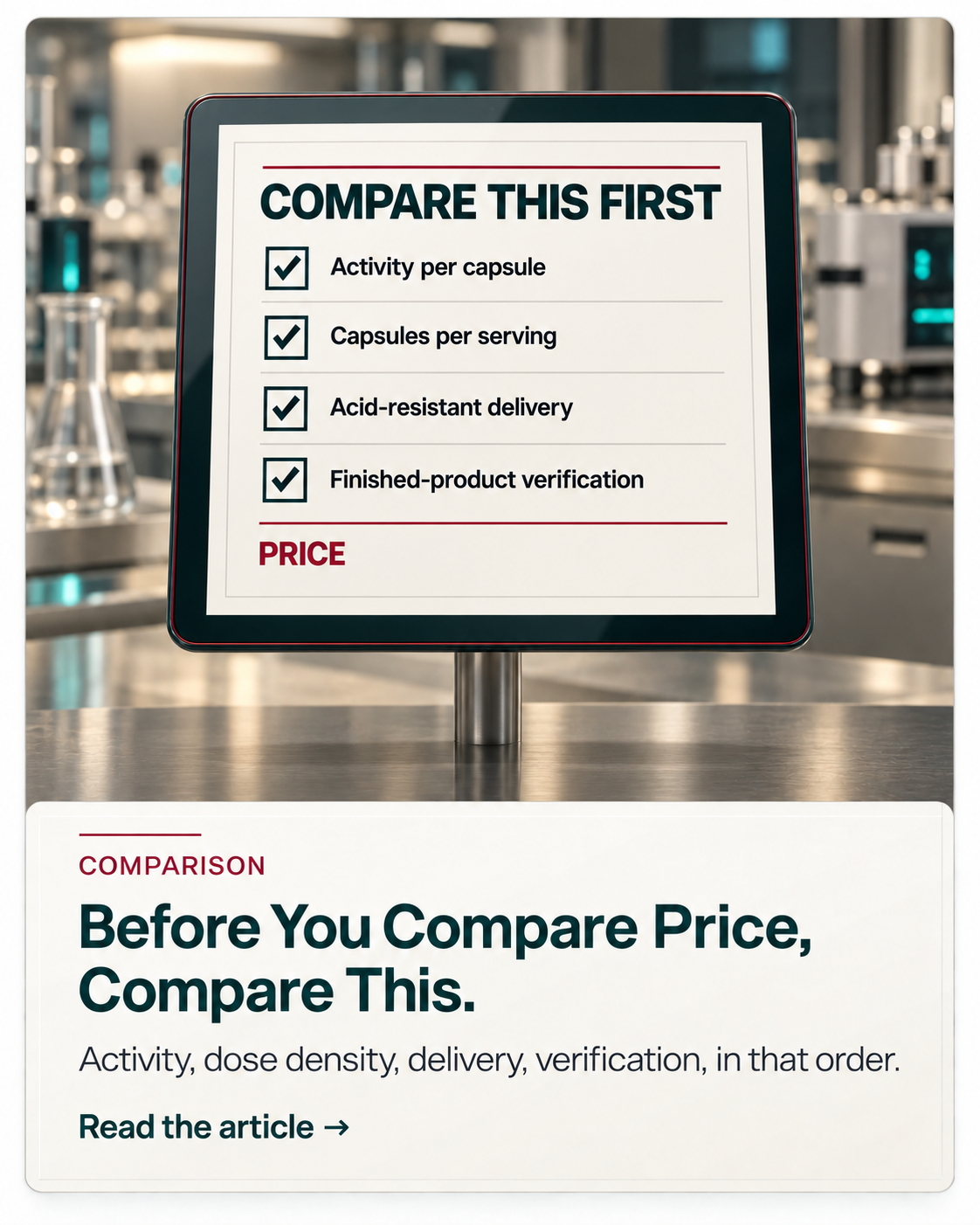
A more useful evaluation asks:
How much activity is actually provided?
Is the FU value clearly stated per capsule or per serving?
How much material is required to deliver that activity?
How was the product formulated and delivered?
What verification supports the stated specification?
And does the manufacturer explain why the product was built the way it was built?
A large number without context tells you very little about formulation quality.
For a broader evaluation framework, see our guide to how to compare nattokinase supplements.
Takeaway
Human research has evaluated nattokinase at 7,000 FU/day for six months, 10,800 FU/day for 12 months, and a 552 mg/day NSK-SD exposure later characterized at approximately 13,000 FU/day.
Those studies tell us that high-FU exposures have been evaluated in humans.
They do not establish a maximum safe dose.
FU also cannot answer the safety question by itself. Medications, bleeding risk and individual circumstances matter.
Better decisions start with understanding what the research actually tested—and what it did not.
Frequently Asked Questions
-
Human research has included exposures above 10,000 FU/day. Chen and colleagues evaluated 10,800 FU/day over 12 months and reported no noticeable adverse effects associated with nattokinase use.
That finding describes the study; it does not establish a universal safe dose.
-
Approximately 13,000 FU/day is an approximate characterization of the Lampe study exposure. Lampe administered 552 mg/day of NSK-SD; the exact FU activity of the human-study batch was not reported.
The tested exposure was well tolerated in 11 healthy adults over 28 days, but the study did not establish 13,000 FU/day as a universal safe dose.
-
Lampe and English evaluated 552 mg/day of NSK-SD for 28 days.
Based on the 20,000–24,700 FU/g activity range of NSK-SD material used across their studies, the estimated exposure was approximately 11,040–13,634 FU/day.
The exact activity of the human-study batch was not reported. Chen later characterized the exposure as approximately 13,000 FU/day.
-
No established maximum safe dose or tolerable upper intake level has been established for nattokinase.
-
Nattokinase has fibrinolytic activity, so combining it with anticoagulant or antiplatelet drugs can raise legitimate safety concerns.
Anyone taking an anticoagulant, antiplatelet drug, aspirin or another therapy affecting coagulation or fibrinolysis should discuss nattokinase use with an appropriate healthcare professional.
-
No. Nattokinase should not be used as a substitute for prescribed anticoagulant therapy. Any change to prescribed anticoagulant treatment should be made only under the direction of the prescribing clinician.
Do not stop, reduce or replace prescribed anticoagulant medication based on nattokinase research or supplement labeling.
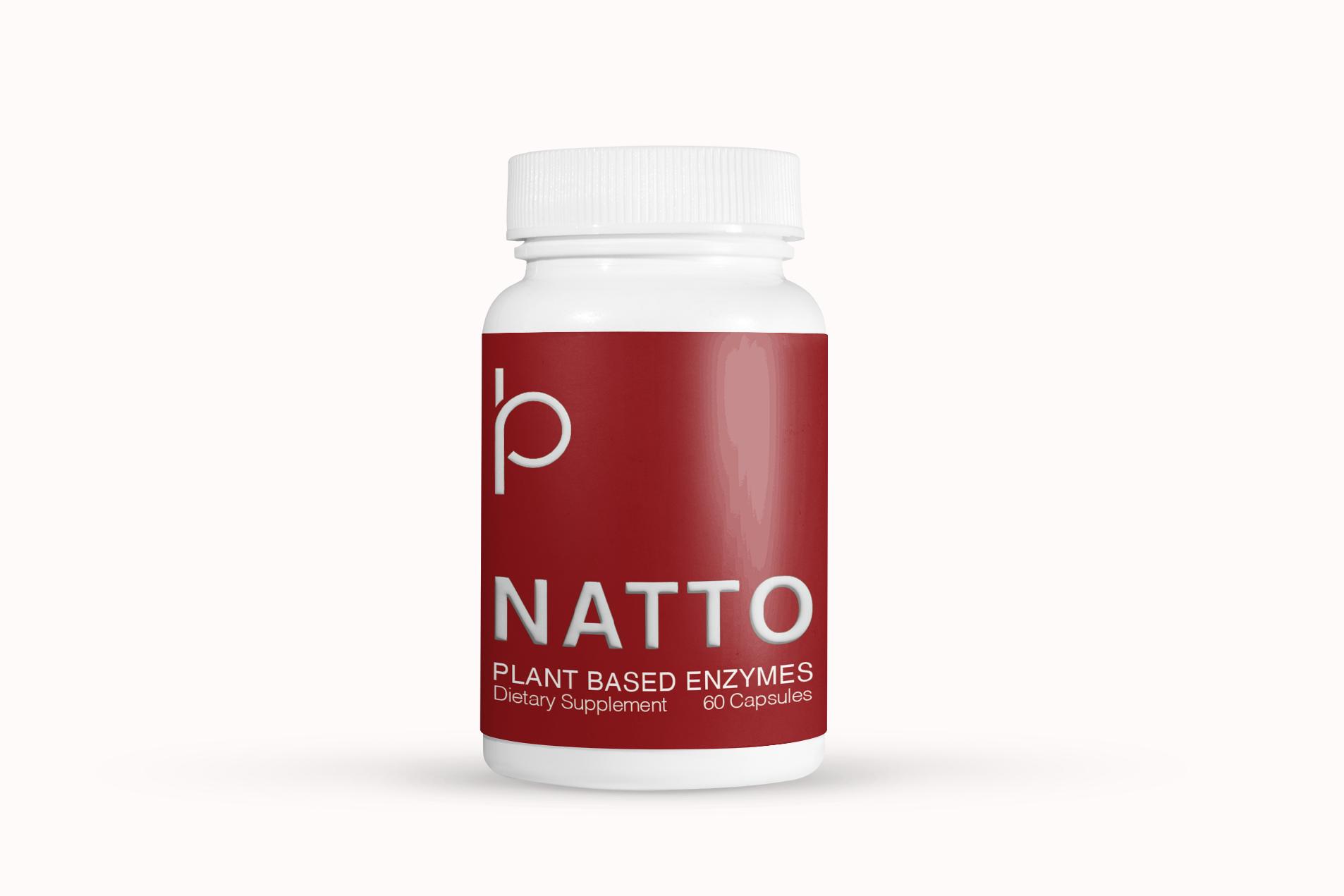
13,500 FU PB Natto
Per Acid-Resistant Capsule
High-potency nattokinase formulated to support cardiovascular health and healthy circulation.
• Guaranteed 13,500 FU per capsule
• Acid-resistant capsule
• One capsule per serving
• 60 servings • Two-month supply • $45 per month
Who should not take this: Individuals taking anticoagulant or antiplatelet medications, those with bleeding disorders, or anyone with an increased risk of bleeding should consult a healthcare professional before use. If scheduled for surgery or an invasive procedure, discuss use with your healthcare professional beforehand.
Flexible payment options are available at checkout.
Explore the Science Behind Nattokinase