

EVIDENCE-INFORMED NUTRACEUTICAL PRODUCT DEVELOPMENT
Built With Purpose. Driven by Evidence.
Perfect Balance Enzymes develops nutraceutical products by turning scientific evidence into deliberate formulation decisions—from activity and dose density to delivery, manufacturing, and a verification strategy appropriate to the finished product.
We don't start with an ingredient list.
We start with the evidence.
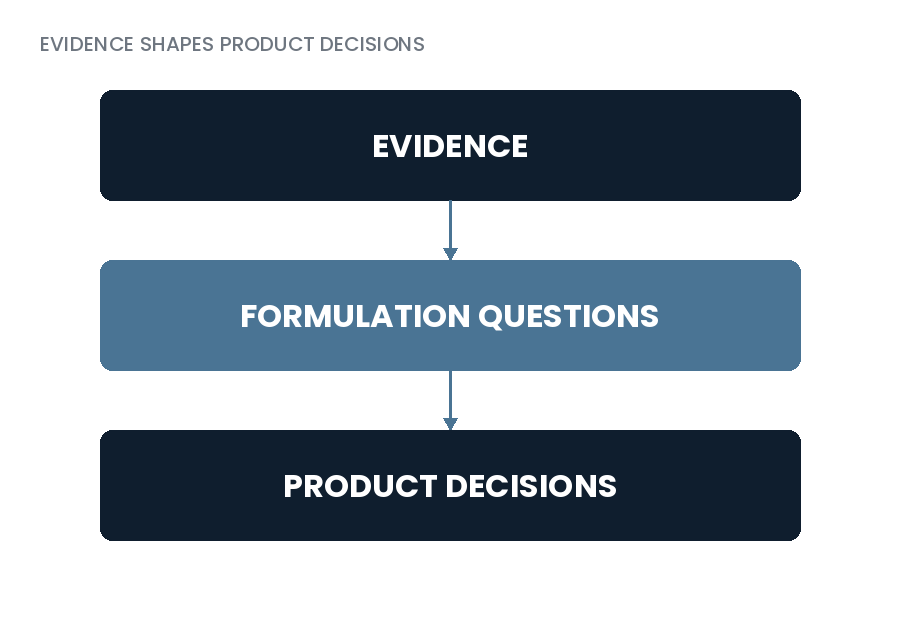
What has actually been studied? At what activity level? In what form? At what dose? What happens after the ingredient is swallowed? What should be measured in the finished product?
We are not simply constructing a supplement. We start by mapping the physiological system, identifying the mechanisms that matter, and asking which interventions can defensibly influence which nodes.
Those questions shape what we build.
At PBE, formulation is not label decoration. It is a sequence of decisions, each with a reason behind it.
That is where product development begins.
The Starting Point
We Don't Start With an Ingredient List. We Start With the Evidence.
A lot of supplement development begins with ingredients:
What should we put in the formula?
PBE starts one step earlier:
What does the science actually support?
That changes the conversation.
Research can tell us what has been studied, what forms were used, what activity levels or doses mattered to the research, where results were strong, where they were mixed, what delivery questions exist, and what remains unanswered.
The goal is not to find a paper that gives us permission to make the biggest claim.
The goal is to build the strongest formulation the evidence allows.
Research defines the scientifically supportable lane.
Then formulation begins.
FORMULATION IS ARCHITECTURE
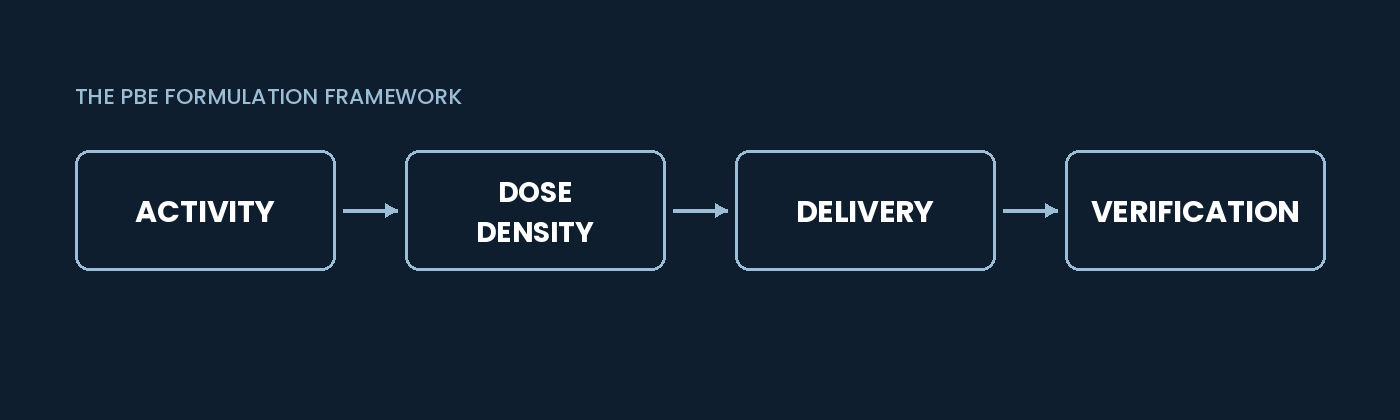
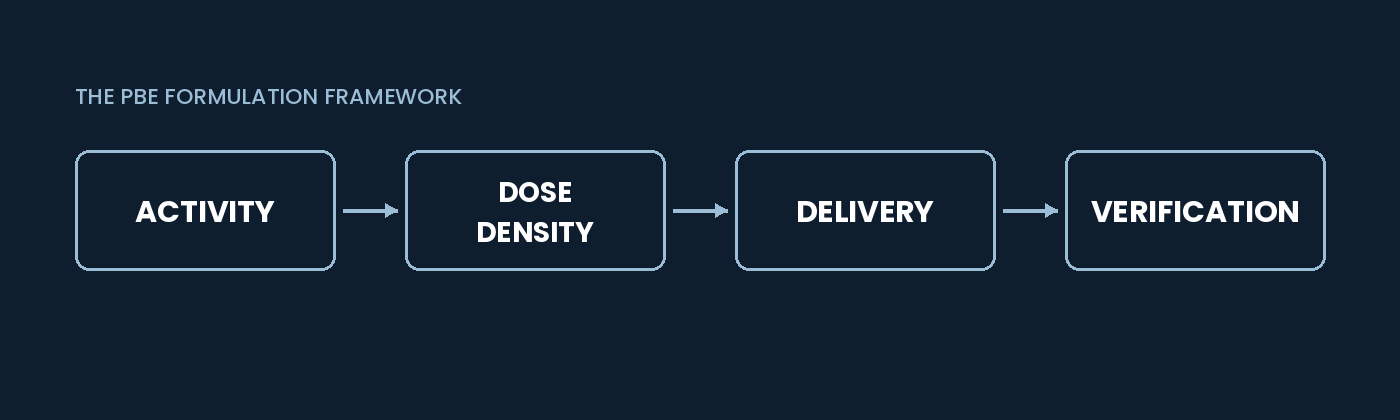
Activity → Dose Density → Delivery → Verification
Four questions sit at the center of how PBE approaches enzyme formulation.
They sound technical. They are actually very practical.
Activity
What measurable activity are we designing around?
For enzymes, milligrams alone do not tell the whole story.
Weight tells us how much material is present. Activity units tell us how active that enzyme preparation is under its defined assay.
FU. HUT. SPU.
Those measurements answer a different question than weight alone.
Dose Density
How much of that activity can be delivered in the intended serving?
Dose is part of the formulation decision.
Once the activity that matters is understood, we ask how that activity fits into a practical serving—not how impressive we can make an ingredient list look.
Delivery
What documentation and testing tell us whether the finished product reflects what we intended to build?
Specifications establish the target.
Manufacturing produces the product.
Verification helps close the loop.
Formulation is architecture.
WHY ACTIVITY MATTERS
Weight and Activity Are Not the Same Measurement.
Dose Is Part of the Formulation Decision.
For enzyme products, weight alone does not tell the whole story.
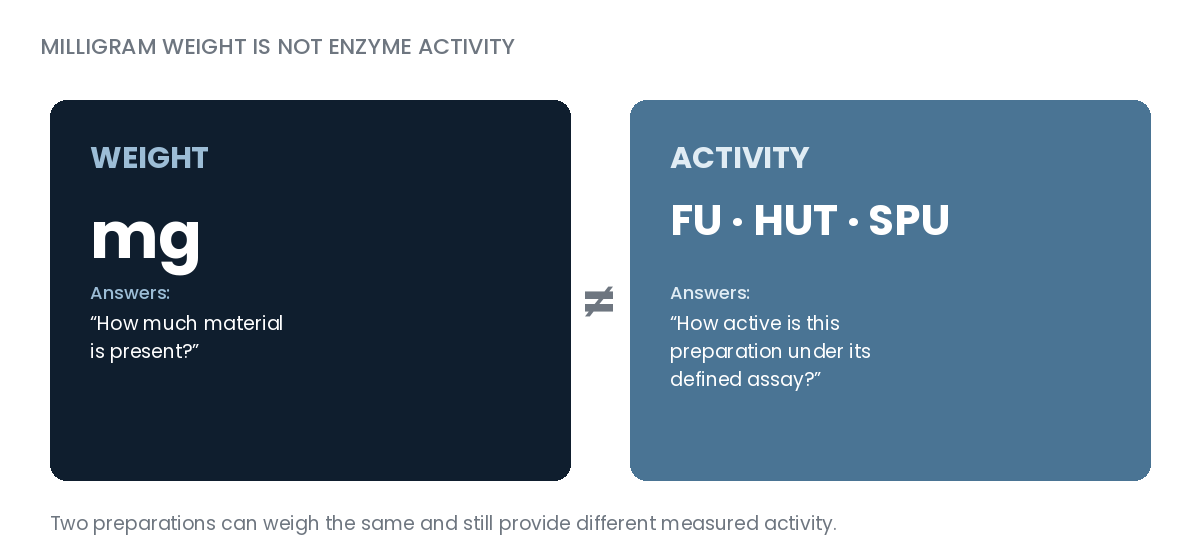
A milligram value tells you how much material is present.
An enzyme-activity unit tells you something different:
how active that material is under a defined assay.
Two enzyme preparations can weigh the same and still provide different measured activity.
That is why PBE does not formulate enzymes by weight alone.
We look at activity.
Then we ask the next question:
How much of that activity belongs in the intended serving?
That is dose density.
It connects measured activity with serving design, capsule count, formulation concentration, manufacturing practicality and usability.
A larger number is not automatically a better clinical outcome.
The point is simpler:
Activity and serving design should be considered together.
DELIVERY IS PART OF THE BUILD
The Capsule Is Not Just Packaging.
You can formulate an active enzyme. Then someone swallows it. What happens next?
That question matters.
Enzymes depend on their environment. Water, temperature, pH and surrounding digestive conditions can affect how they behave.
Nattokinase-specific research showed PBE that gastric conditions deserved serious attention.
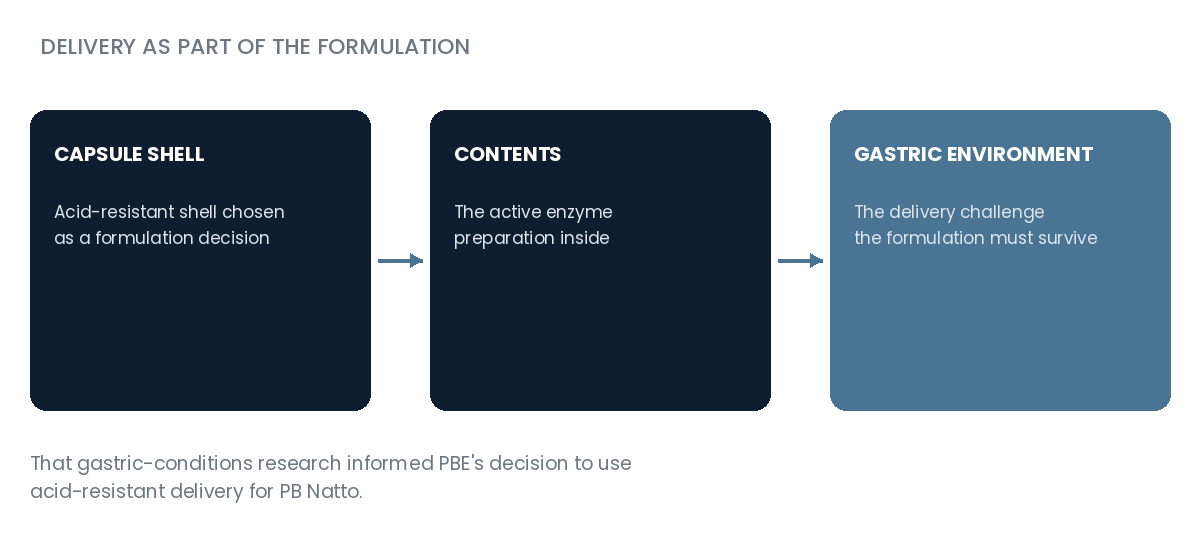
Research shows nattokinase activity is reduced or degraded under gastric conditions.
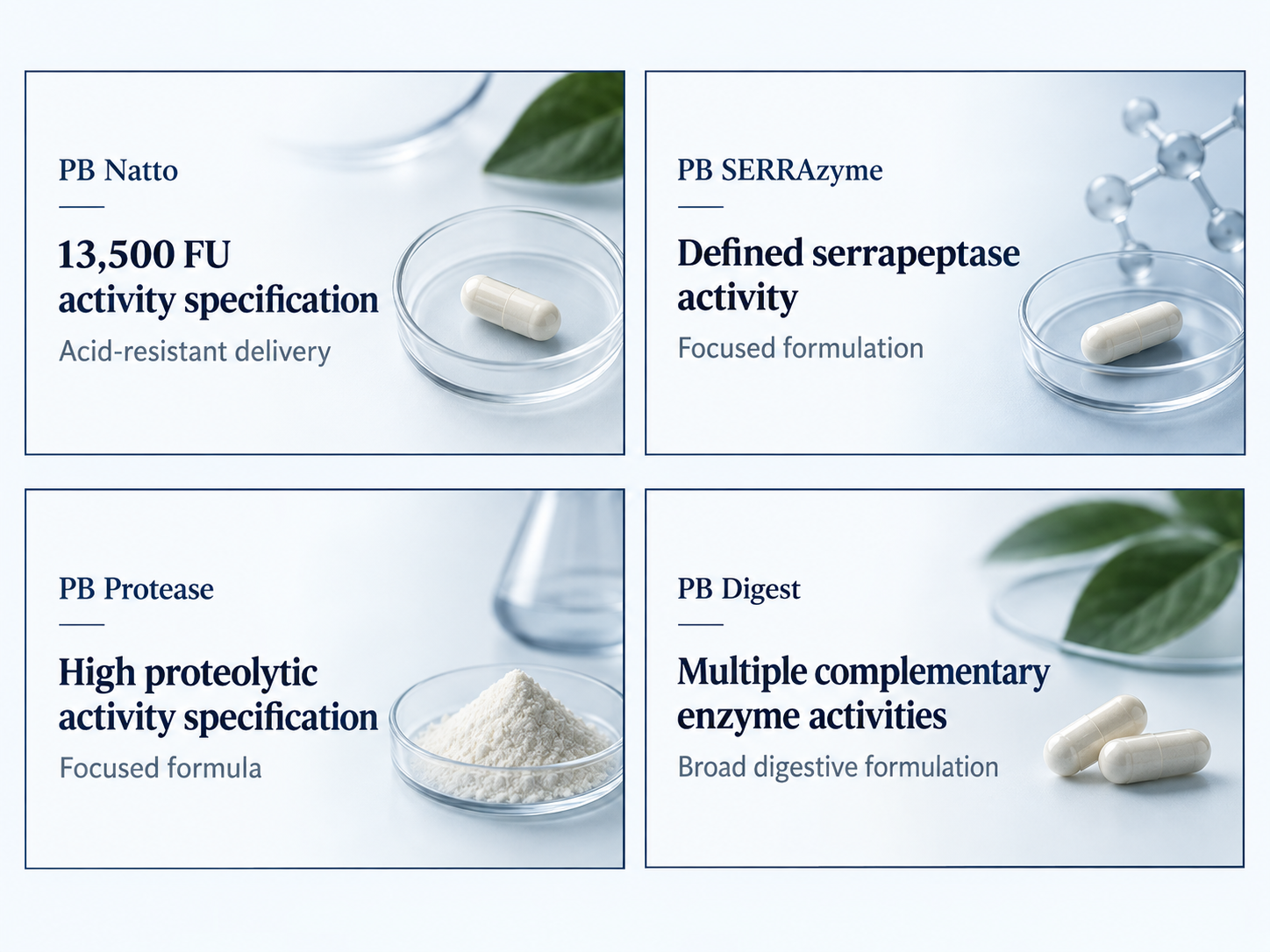
That scientific rationale informed PBE's decision to use acid-resistant delivery for PB Natto.
The larger principle goes beyond one product:
Delivery is not something we think about after formulation. Delivery is part of the formulation.
The dosage form should have a reason for being chosen.
The capsule is not packaging. It is part of the formulation strategy.
THE DESIGN HAS TO SURVIVE PRODUCTION
A Good Formula Still Has to Be Manufactured Well.
A formulation does not become a product when the spreadsheet is finished.
It has to become something that can actually be manufactured.
That means translating the formulation into raw-material requirements, target weights, activity specifications, blend ratios, capsule-fill requirements, process instructions, production records and finished-product specifications.
This is where product development becomes operational.
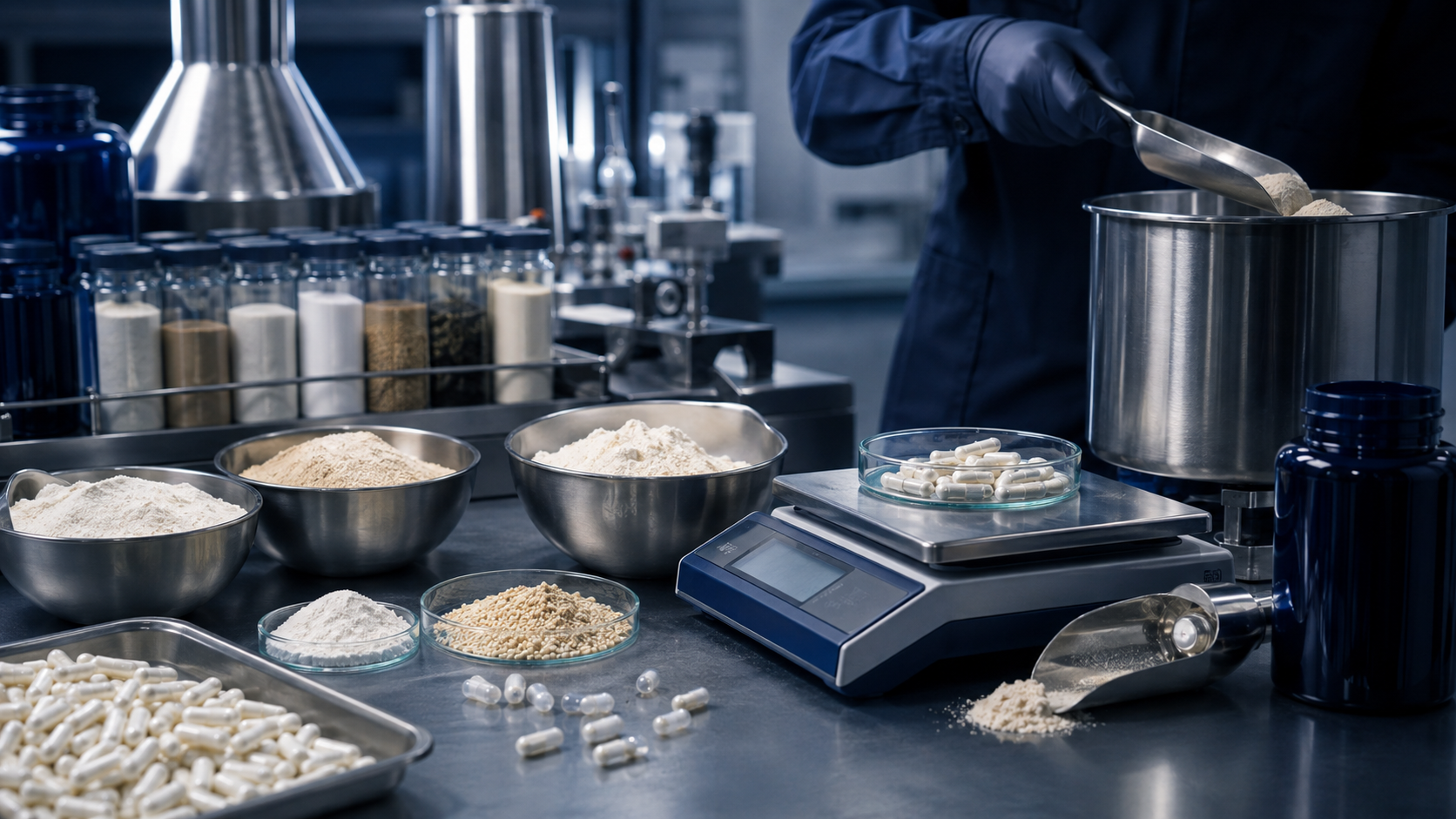
Formulation does not stop at the spreadsheet.
The design has to survive sourcing, blending, encapsulation and finished-product production.
Manufacturing has to reproduce the formulation we designed.
If the manufacturing process cannot reliably produce the intended specification, the formulation is not finished.
WHAT WENT IN. WHAT CAME OUT.
A Raw-Material COA Tells Us What Entered Production. Finished-Product Testing, Where Performed, Tells Us What Came Out.
Raw-material documentation matters.
It tells us about the material selected before manufacturing.
But after that material has been weighed, blended, encapsulated, handled and turned into a finished product, another question matters:
What did we actually manufacture?
Raw-material documentation and finished-product verification answer different questions.
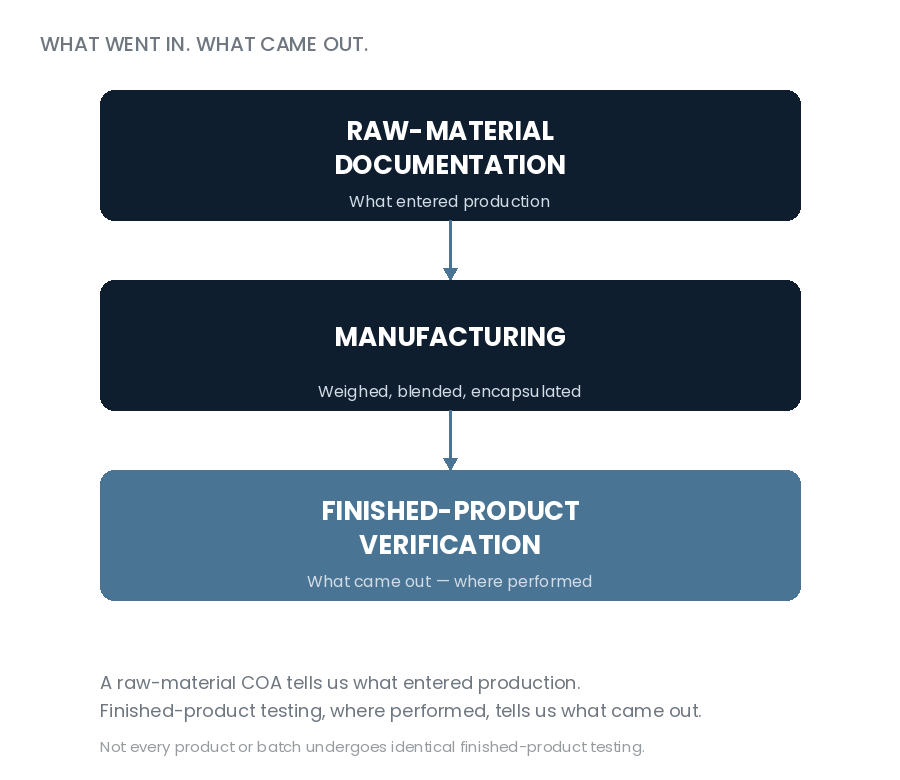
PBE incorporates third-party finished-product testing into its verification strategy where applicable.
For tested products or batches, finished-product documentation may be available upon request where applicable.
The purpose is not paperwork for the sake of paperwork.
The purpose is to close the development loop.
Specification → Manufacturing → Verification
Did the finished product meet the specification we intended to build?
That answer can inform the next production decision.
Define it. Build it. Verify it.
EVIDENCE IS NOT BORROWED MARKETING
Research Is Not Borrowed Marketing.
Published science is valuable because it helps us understand what is worth paying attention to.
It can tell us what was studied, what activity or dose was used, how long researchers followed it, what they measured, what they observed and what questions remain open.
But evidence does not need to become a borrowed promise.
The more useful progression is:
What was tested
→ What researchers observed
→ What PBE learned
→ How that informed product development
That is how the nattokinase literature influenced PB Natto.
Research around activity and dose informed the questions PBE asked about potency and serving design.
Research around gastric conditions informed the decision to use acid-resistant delivery.
Verification became part of the product-development question too.
The science became product development.
DELIBERATE BY DESIGN
Every Component Needs a Reason.
PBE does not measure formulation sophistication by ingredient count.
More ingredients do not automatically make a better product.
Fewer ingredients do not automatically make a better product either.
The formula should follow the job.
A focused product may need one core active.
A broad digestive formulation may require multiple complementary enzyme activities.
The question remains:
Why is this here? Every ingredient. Every activity level. Every serving decision.
Every capsule choice. Every manufacturing step. Every specification. Every component needs a reason to be there.
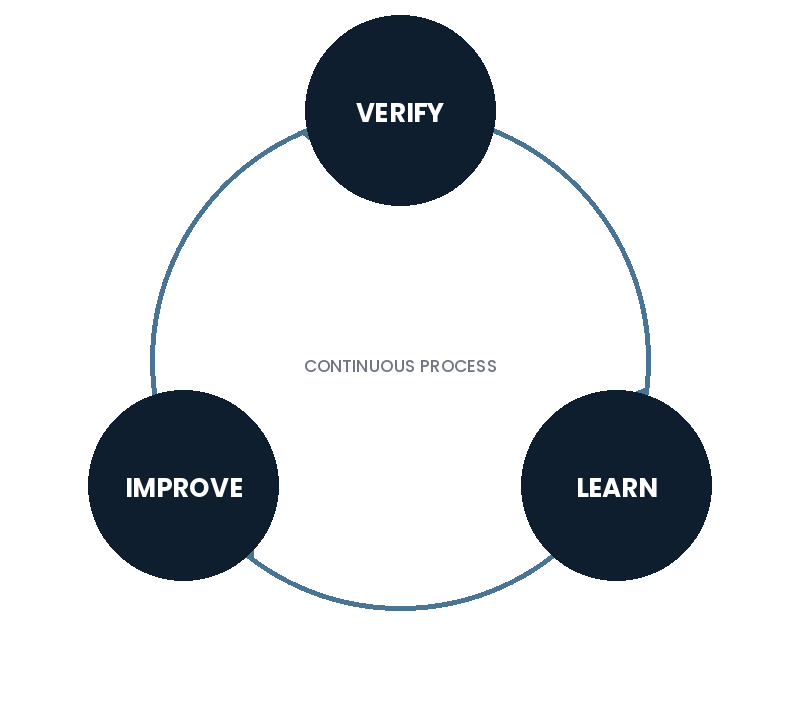
And product development does not end when the bottle is filled. Verification gives us information. Production gives us information. New research gives us information.
What we learn should inform what we do next.
Verify. Learn. Improve.
THE QUESTIONS BEHIND PBE
Better Questions Build Better Products.
What does the evidence actually show?
What activity matters?
What dose density makes sense?
What happens after the product is swallowed?
Can the formula be manufactured consistently?
What should we verify in the finished product?
What did we learn?
What should we improve next?
Those are the questions behind PBE.
We are curious enough to ask them.
Disciplined enough to follow the evidence.
And practical enough to turn the answers into products people can actually use.
Curiosity starts the process. Evidence decides where it goes.
And when the science supports the decision, we do not back away from it.
We build.
We verify.
We learn.
We improve.
That is how the science becomes product development.